

.png)
2025 in review: The trade shifts that defined a turbulent year
What you’ll learn in this article:
- Which countries are the winners and losers amid 2025’s global-trade turmoil.
- How new datasets and AI-powered analytics are raising the trade-data game.
- The value of America’s trade data leadership for business and the world.
🎯 Best for: Supply chain managers, VPs of global strategy, Chief Executives.
The year 2025 will be remembered in history as one of the most tumultuous ever for global commerce. Amid ever-changing tariff rules and shifting alliances, global trading relationships are being realigned on the fly — and the value of accurate, reliable trade data has never been higher.
Data compiled by ImportGenius shows that, for the first ten months of 2025 vs 2024, shipments from China are down by 6%, while Vietnam, India, Thailand and Cambodia all registered double-digit gains, compared to the same time period in 2024.
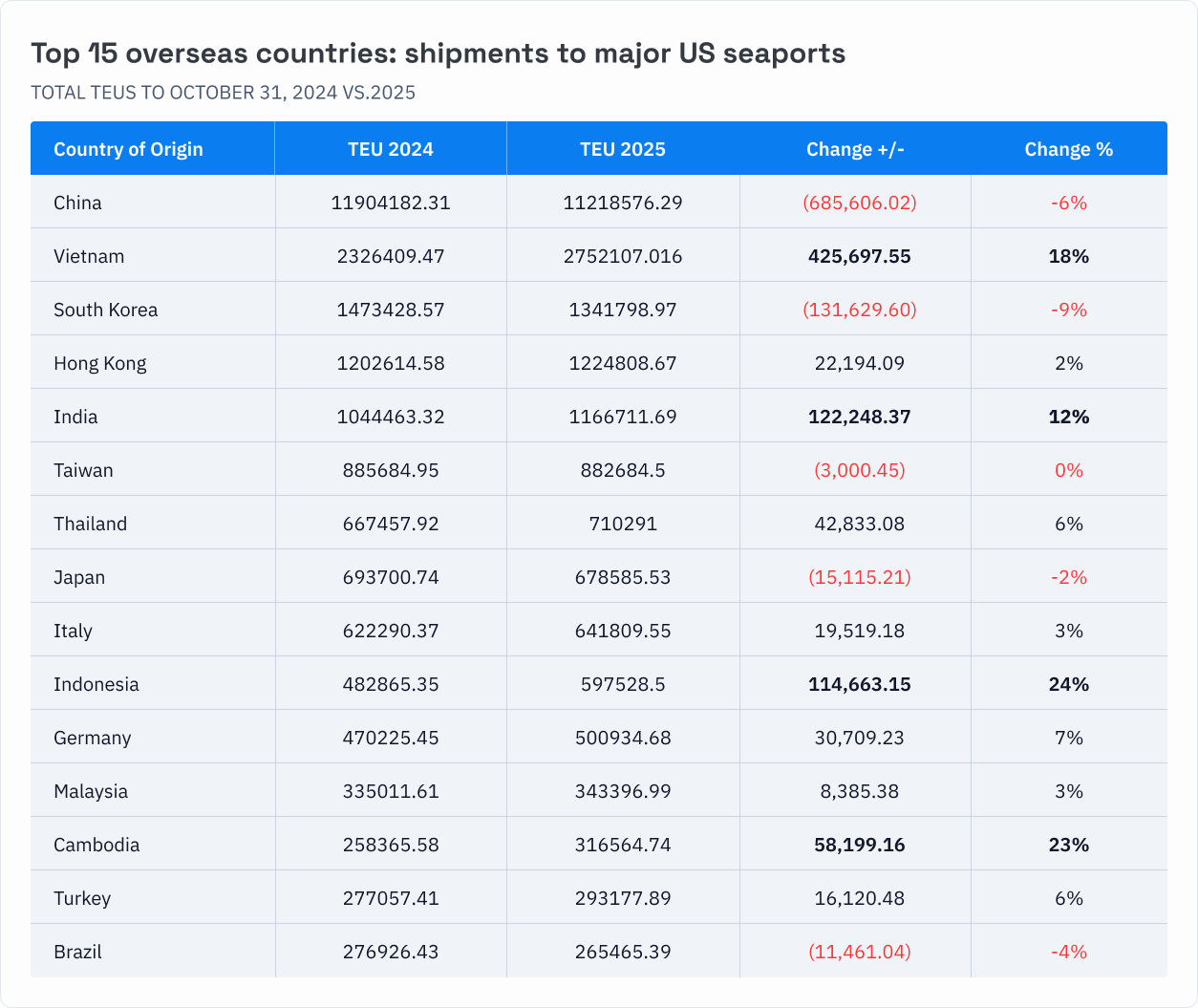
The data for 2025 tells a story of shifting global trade patterns. Those shifts are likely to continue in the months ahead, and keeping track of them has become a crucial task for every business.
That has made 2025 a crucial year for companies, such as ImportGenius, that provide access to trade data. “Businesses not only need better data now, they need more of it — lots more,” says ImportGenius CEO Michael Kanko. “They are looking at new markets and new suppliers, at doing business in countries they’ve never considered before. The stakes are high for every decision, and there’s a lot riding on the data they use to make them.”
Trade data coverage expands to meet demand
With so many countries rising up the leaderboard of U.S. import sources, the value of data from those countries has risen significantly. In previous years, U.S. trade data alone might have been sufficient as a source of trade intelligence, but now there is a premium on other countries’ trade data as well.
That has sent data providers in search of additional datasets for their clients. ImportGenius, for example, has added six new country datasets so far this year, with a seventh to launch before the end of the year: Mexico, Cameroon, Pakistan, Vietnam, Indonesia, the Philippines and Sri Lanka (in December).
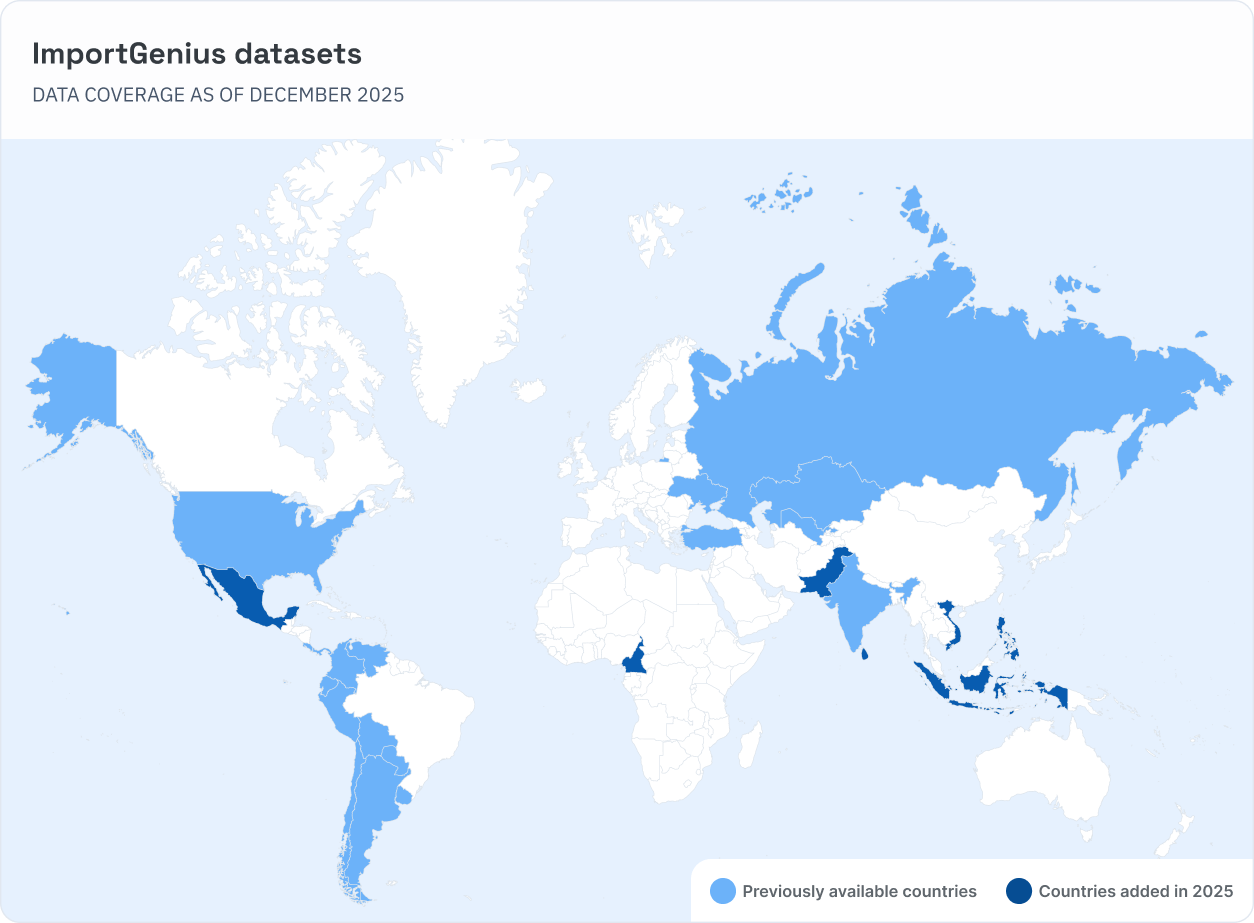
Mexican data in particular has become highly sought-after. U.S. data releases are limited to shipments by sea, which covers the vast majority of overseas trade — but trade with Mexico arrives largely overland, either by road or by rail. According to the U.S. census bureau, trade with Mexico increased by 6.3% in the first six months of 2025, making access to that data more important than ever.
ImportGenius’ Mexico and Mexico-U.S. Border datasets provide full visibility into the world’s busiest trade corridor at all crossings, including Laredo, El Paso and Otay Mesa. “Mexico has become a crucial trade hub between the U.S. and the rest of the world,” says Kanko. “With full visibility into that trading relationship, businesses can assess how Mexico can best support their international supply chains.”
AI-powered data analytics drive increased speed and value
Trade datasets are dense and complex, providing manifest-level detail with itemized records for every import including shippers, consignees, product descriptions and more. That makes trade data an ideal use case for artificial intelligence, which has the ability to parse through millions of records in minutes — a task that would take most humans hours, if not days.
“Trade data companies, including ours, are adopting AI faster than many other sectors,” says Kanko. “We’re still discovering all the ways it can be used to improve both data accuracy and analytics.” The ImportGenius platform uses AI for its Company Profiler, which provides detailed information on any company identified in a trade data search, and for HS code enrichment — assigning accurate HS codes to datasets that don’t provide them.
Greater transparency helps business, protects consumers
While many countries, including major U.S. trading partners such as China and Canada, continue to keep their trade data inaccessible to the public, transparency is increasingly the norm. “The United States has been providing access to manifest-level shipment detail for decades, and it’s been a key ingredient to America’s success in the world,” says Kanko. “Access to trade data not only keeps American businesses globally competitive, it also helps ensure fairness and consumer safety.”
In 2025, trade data has shaped dozens of news headlines, including the discovery of radioactive shrimp shipments from Indonesia and NVIDIA’s potential skirting of trade restrictions to send banned AI chips to China. Trade data was even used to predict the current shortage of artificial Christmas trees on store shelves.
The past year also saw the introduction in Congress of the Manifest Modernization Act of 2025, which would expand U.S. trade data transparency to include air, rail and road freight. The Act has yet to be put to a vote; ImportGenius CEO Michael Kanko, who appeared before Congress in 2023 to support the Act’s adoption, strongly supports the legislation.
Obtain access to a wealth of information
As the calendar turns to a new year, global merchandise trade is beset with greater risk than in years past. That’s why trade data is emerging as a primary tool for business strategists, whether the objective is to explore new markets, find new partners, track competitors, diversify supply chains or spot emerging trends.
“There are lots of misleading indicators and false trends out there, but containers don’t lie,” says Kanko. “Trade data is like the source code to the global economy. Once you know how to read it, it gives you the power to shape its outcomes.”
[CTA]

Ready to dive deeper?

Ready to dive deeper?


More blogs & reports


